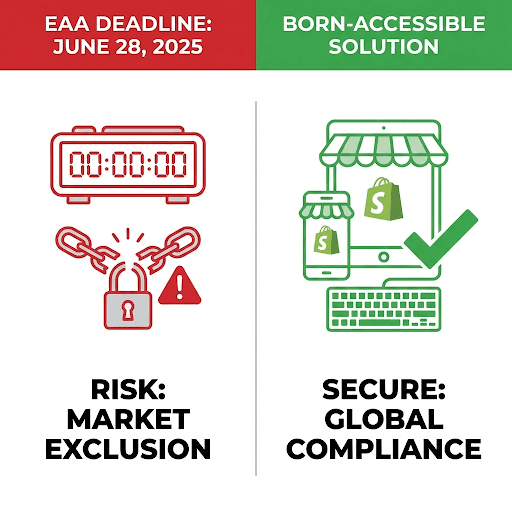
EAA Enforcement is Here: Why Your US Shopify Store is Now at Risk

For the last twenty years, web accessibility in e-commerce was viewed largely as a "nice-to-have"—a discretionary optimization for user experience or a checkbox for Corporate Social Responsibility.
That era has definitively closed.
On June 28, 2025, the digital commerce landscape underwent its most profound structural transformation since GDPR. That was the enforcement date for the European Accessibility Act (EAA), a directive that fundamentally redefines the concept of market access—and that deadline has now passed.
Here is the hard truth that most US-based merchants are ignoring: The EAA is not just a recommendation. It is a product safety directive. Under this new legal framework, a Shopify store that is inaccessible to users with disabilities is legally categorized as a "defective product," unfit for sale within the European Single Market.
If you are a Shopify merchant based in New York, Toronto, or Sydney, you might be tempted to think, "This is a European law; it doesn't apply to me."
You would be wrong. And that assumption could cost you your entire European revenue stream.
The EAA's reach is explicitly extraterritorial. It applies to any economic operator "placing products or services on the market" in the EU, regardless of where they are headquartered. If a customer in Berlin or Paris can access your site, browse your products, and attempt a purchase, you are liable.
In this strategic guide, we will break down exactly why the EAA is a critical threat to non-compliant merchants, expose the "microenterprise" trap that leaves small businesses vulnerable, and explain why your current "accessibility widget" might actually be painting a target on your back.
The "Extraterritorial" Reality: Why Geography Won't Save You
A common misconception among North American merchants is that EU directives stop at the Atlantic Ocean. In the case of the EAA, this is dangerously incorrect.
The Directive applies to any "economic operator" that places products or services on the EU market. The key phrase here is "placing on the market."
If your Shopify store ships to Germany, France, or Italy, and a consumer in those countries can access your site to make a purchase, you are "placing on the market". It does not matter if your HQ is in Austin, Texas, or Melbourne, Australia.
The law defines "e-commerce services" comprehensively. It captures the entire transactional lifecycle: from product discovery and the "add to cart" mechanism to authentication, checkout, and even post-purchase customer support. If a blind user in Dublin cannot navigate your checkout flow using a screen reader, you are not just losing a sale—you are violating EU law.
The "Microenterprise" Exemption: A Strategic Trap
Many small merchants breathe a sigh of relief when they read about the "microenterprise" exemption. The EAA technically exempts service providers with fewer than 10 employees and an annual turnover under €2 million.
However, relying on this exemption is a strategic trap for three critical reasons:
The "Growth" Trap: The definition of a microenterprise is dynamic. You might start the fiscal year under the threshold, but a successful Black Friday or a seasonal staffing expansion could push you over the line. If you cross that threshold, you face immediate non-compliance risks, forcing an emergency remediation that is far more expensive than building accessibly from the start.
The Product vs. Service Distinction: This is where it gets technical. The exemption applies primarily to services. If you sell digital products (like e-books or PDFs) or physical hardware (like e-readers or tablets), those products must be accessible regardless of your company size. A small publisher might be exempt for their website but liable for the inaccessible PDF they sell.
National Variations: The EAA is a Directive, meaning EU member states transpose it into their own national laws. Some countries, like Italy, have historically rigorous accessibility laws that may apply to private entities in ways that bypass standard exemptions.
The Cost of Non-Compliance: It's More Than Just a Fine
Unlike the US system, which relies on private lawsuits (the "settlement economy"), the EU model uses administrative enforcement. This means you aren't just dealing with a lawyer; you are dealing with a government.
The penalties are required to be "effective, proportionate, and dissuasive," leading to severe consequences across different jurisdictions:
Ireland (The Corporate Liability Hub): As the EU headquarters for many tech giants, Ireland's laws are critical. They allow for fines of up to €60,000 for summary convictions. More alarmingly, severe breaches can lead to imprisonment for corporate officers for up to 18 months. This introduces personal liability for directors—a risk factor completely absent in most US civil litigation.
Germany (The Digital Blockade): The German implementation (BFSG) empowers market surveillance authorities to order the suspension or termination of services. For a Shopify merchant, this could manifest as an order to payment processors or ISPs to cease facilitating transactions for your store in Germany.
France (The Cumulative Fine): French authorities can levy fines up to €25,000 per infraction. Because they have a mechanism for cumulative penalties, systemic failures across a large site could theoretically stack up to hundreds of thousands of Euros.
The False Promise of Automated "Overlays"
In response to the rising tide of litigation, a burgeoning industry of "accessibility overlays" or "widgets" has emerged. You've likely seen their ads promising "instant compliance" via a single line of JavaScript.
It sounds like the perfect solution: cheap, automated, and effortless.
But there is a reason leading accessibility experts advise against them. In fact, relying on these tools as your primary compliance strategy is not just technically insufficient—it can actually increase your legal exposure.
1. The Technical Failure (Speed Matters)
Overlays function by modifying the code in your browser after the page has loaded. However, screen readers (the software used by blind users) interact with the underlying code (the DOM) immediately. Because of network latency, the screen reader often parses your "broken" site before the overlay script has even finished executing. The user gets the error before your "fix" arrives.
2. They Don't Fix the Core Problems
Overlays create a superficial "skin" of accessibility. They cannot repair deep structural issues inherent in your Shopify theme, such as missing form labels, illogical heading hierarchies, or keyboard traps within third-party apps. If a user gets stuck in a "mega menu" because of bad code, a widget cannot programmatically free them.
3. The Legal Reality Check
Courts and regulators are increasingly rejecting overlays as a valid defense. In a landmark 2025 action, the Federal Trade Commission (FTC) fined a major overlay provider $1 million for deceptive advertising regarding its compliance guarantees. Furthermore, litigation data shows that over 800 businesses utilizing accessibility widgets were sued in a single year.
Far from being a shield, legal experts note that the presence of a widget can act as a "flag" to plaintiffs' lawyers. It signals that a merchant is aware of accessibility issues but has opted for a "band-aid" solution rather than genuine remediation.
The Only Viable Path: Code-Level Remediation
If widgets are out, what is the solution?
The only defensible strategy is "source code remediation"—fixing your actual theme code and content to be natively accessible. This approach, often called "born-accessible," ensures your store complies with WCAG 2.1 AA (the legal standard) and is robust enough for the future.
Here is what a genuine remediation strategy looks like for a Shopify store:
Restoring Focus Indicators: Many themes suppress the visual ring that appears around buttons when using a keyboard to satisfy aesthetic preferences. This makes the site unusable for sighted keyboard users. You must restore this using
:focus-visibleCSS to ensure navigation is visible.Semantic HTML Structure: Screen reader users navigate by headings. If your theme uses H1 tags for styling rather than structure, it creates a chaotic experience. Remediation involves auditing your Liquid templates to ensure a strict hierarchy (one H1, followed by logical H2s).
The Third-Party App Audit: Apps are the single largest source of accessibility degradation. A reviews widget or chat popup can introduce "keyboard traps" that you cannot edit. You must vet every app you install and request a VPAT (Voluntary Product Accessibility Template) from the developer.
Addressing Your Concerns
"I'm Just a Small Business. Will They Really Find Me?"
This is the most dangerous assumption a merchant can make. The data proves otherwise.
In the US litigation landscape, 77% of digital accessibility lawsuits target companies with under $25 million in annual revenue. Why? Because small to medium-sized businesses are often seen as "low-hanging fruit" by serial plaintiffs. They lack the massive legal teams of a Fortune 500 company and are more likely to settle quickly to avoid the costs of a defense.
In Europe, the risk is even more systemic. Market surveillance authorities use automated crawling tools to scan thousands of sites simultaneously. Being "small" doesn't hide you from a bot.
"Isn't Remediation Too Expensive?"
It is important to reframe the cost. Think of accessibility remediation as a one-time investment versus a recurring tax.
The "Settlement Tax": The average ADA settlement demand ranges from $5,000 to $25,000. But settling doesn't fix your site. It just makes the lawsuit go away for that specific plaintiff. It leaves you open to the next one.
The Defense Cost: Fighting a federal lawsuit through to summary judgment can easily exceed $50,000 to $100,000 in legal fees alone.
The Remediation Investment: By contrast, a code-level audit and remediation is a finite project. Once your templates are fixed (e.g., your H1 tags are structured, your focus rings are visible), they stay fixed until you change the code again.
Frequently Asked Questions about EAA and Shopify
Does the European Accessibility Act apply to US companies?
Yes. The EAA is extraterritorial. It applies to any "economic operator" that places products or services on the EU market. If you sell to consumers in the EU via your Shopify store, you must comply, regardless of where your company is headquartered.
What are the fines for EAA non-compliance?
Penalties vary by member state but can be severe. In Ireland, fines can reach €60,000 with potential imprisonment for directors. In France, fines can be up to €25,000 per infraction. In Germany, authorities can order the suspension of your service, effectively blocking your digital storefront.
Is my Shopify store accessible out of the box?
No. Shopify operates on a "shared responsibility" model. While Shopify ensures the core checkout is accessible, you are fully responsible for your theme, content, and installed apps. Even the reference "Dawn" theme requires code adjustments for full compliance.
Do I qualify for the EAA microenterprise exemption?
Likely not for everything. While companies with fewer than 10 employees and €2 million turnover are exempt from service requirements, they may still be liable for products they sell (like e-readers or hardware). Furthermore, seasonal sales spikes can push you over the threshold, creating immediate liability.
Conclusion: The Era of "Wait and See" Has Ended
The deadline of June 28, 2025, has passed, and enforcement is now active. The European Accessibility Act has transformed accessibility from a passive recommendation into a rigid market entry requirement. Concurrently, US litigation continues to punish negligence with increasing frequency.
For Shopify merchants, the path forward is unambiguous. You must reject the false security of automated overlays and embrace genuine, code-level accessibility. Non-compliant stores are now actively at risk of enforcement actions, fines, and service suspensions.
Don't wait for a demand letter or a regulator's notice to force your hand—compliance is no longer optional.
Learn more: Why accessibility widgets fail, the 2025 alt text mandate, and how accessibility drives SEO.
Ready to secure your storefront?
Contact us today for a comprehensive EAA & ADA Compliance Audit. We will review your theme, app stack, and user flows to identify your risks and build a remediation roadmap to achieve compliance now.
Don't wait for a demand letter or a regulator's notice to force your hand.